

 |
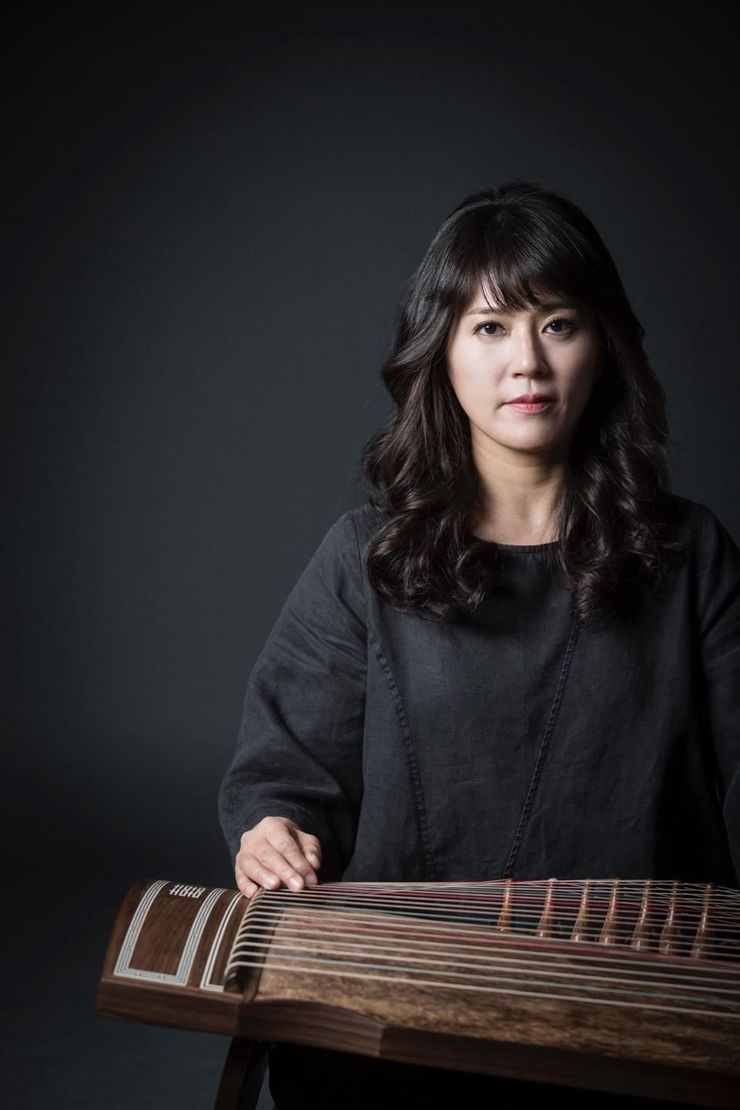
| Gayageum player Park Soon-a / Courtesy of Park Soon-a Music |
By Park Ji-won
For some, music is just something to enjoy. But for Park Soon-a, a 52-year-old player of the Korean traditional string instrument named gayageum, who was born in Japan as a third-generation ethnic Korean, largely referred to here as “Zainichi” Korean, and who learned the instrument in both Koreas, music is a way to find her identity and communicate with the world. It is also a means for her to comfort people who live in their home countries as aliens.
Park is a rare musician having living experience in the two Koreas as well as in Japan: she was born in Japan, spent years in North Korea to learn gayageum and chose to acquire South Korean citizenship to pursue her professional career as a gayageum player.
“As a Zainichi Korean, I’ve lived as a minority in all three countries. In Japan, I didn’t have voting rights and wasn’t part of the society. My life in North Korea was not very different. I went there to study gayageum and lived there for some 10 years,” she told The Korea Times. “Due to my minority status, I was nobody. But now as a grown-up, I think it is the time to speak up about myself and share my experiences as well as the sufferings of others through music.”
In the performance titled “Become Radiant,” she is set to play tracks from her 2020 album “Chan: become radiant,” during the Yeowoorak Music Festival, the largest-gugak-themed festival, held at the National Theater of Korea in Seoul, Wednesday. Being recorded at the now-defunct Armed Forces’ Gwangju Hospital, it aims to comfort the souls of the victims of the Gwangju massacre with her colleagues Yeo Seong-ryong (Percussion), Kang Hae-jin (Violin) and Kim Seong-bae (Bass).
Born in Osaka, Japan, Park started to learn the instrument as a hobby. She realized she was talented at the instrument after she passed an audition to select a student to study in North Korea.
She never intended to become a musician. But as a minority, she didn’t have many other choices. Having not much access to jobs as a second-class citizen, playing the gayageum was almost the only option she had.
“As a Zainichi Korean, who went to ethnic Korean school in the Zainichi community, I had to learn a traditional instrument as an after-school activity. I chose to learn gayageum when I was in the fourth grade and people said I am very good at it,” she said. “I joined an audition to select a Zainichi student who would learn music at the Pyongyang University of Music and Dance in the North on the second grade in my high school in 1985. I was chosen. During every long school break, I traveled to the North and learned gayageum until 1997 all expenses paid. I was also a member of Geumgangsan Art Troup, a Zainichi art troupe founded in 1955 which was named by former North Korean leader Kim Il-sung, performing in North Korea and throughout Japan.”
 |
| “Become radiant,” a gayageum performance played by Park Soon-a during the Yeowoorak Music Festival / Courtesy of National Theater of Korea |
While remaining “Chosen-seki,” ― making her stateless which is the fate of many Zainichi Koreans ― she learned the instrument in the late 20th century in the North when the country actively “reinvented” traditional instruments, expanding their sonic range, and used them for the country’s various musical propaganda activities.
The gayageum was originally a 12-string instrument, but it was transformed into a 21-string instrument in the North while South Korea preserved the original form until it introduced a 25-string gayageum from the late 1990s.
“The two Koreas share the same tradition. But after the separation, North Korea accepted the musical styles of China and Russia under communism and largely changed its music style which is sometimes similar to classical music so to raise the people’s morale. Pyongyang doesn’t preserve so-called traditional music. However, South Korea has been preserving original forms of palace music and other traditional forms.”
There was a time when she was seriously considering quitting music. For eight years between 1998 and 2004, she had been looking for ways to find another job in Japan.
But she realized there were not many options to pursue there. After years of trial and error, she concluded that she should continue pursuing a career as a professional gayageum player.
“I abandoned my Chosen-seki status. It was a huge decision because giving up the status was considered betrayal in the community. But I was certain about my decision that I wanted to learn traditional Korean music in South Korea. I came to South Korea, acquired South Korean citizenship, and studied it, thinking it would be my last chance to fulfill my yearning for learning,” she said.
So, she came to South Korea in 2005. It then took some 10 years to acquire South Korean citizenship due to strict conditions she had to meet while she was studying at the Korean National University of Arts.
She said her experiences as a minority in the two Koreas and Japan helped her open her heart to marginalized people.
[INTERVIEW] Japanese-born ethnic Korean musician comforts minorities with music
Source: Buhay Kapa PH


0 Comments