

 |
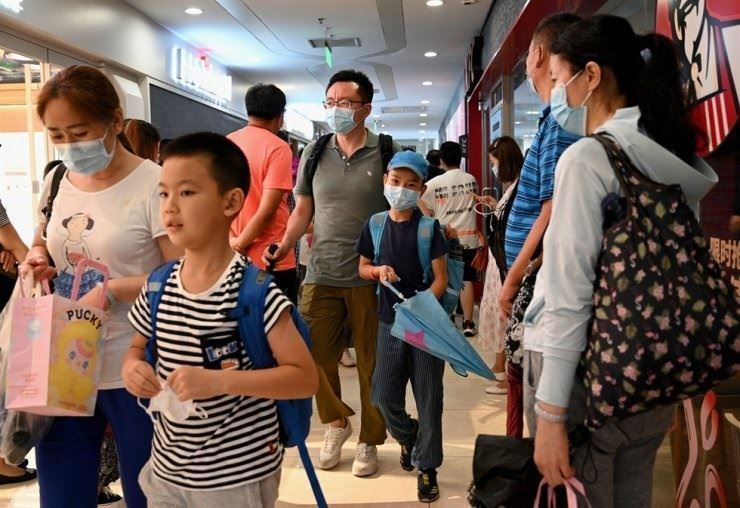
| In this July 29 photo, students and parents leave after attending private after-school education in the Haidan District of Beijing. AFP-Yonhap |
.jpg?1) |
China’s education ministry has publicly released the names and offences of people, schools and companies who violated the rules and regulations directed at the private tutoring industry this summer.
In a post published on the official government website Tuesday, the Ministry of Education (MOE) wrote it had “discovered and handled a number of typical cases of off-campus training violations” before listing five cases of the perpetrators.
In a case from Beijing, five teachers were taking after-school tutoring jobs, which now violates the regulations. The ministry listed their surnames, the school they worked at and the subject they taught.
“After investigation and verification, the relevant district education committee gave warnings to the above five teachers involved and removed them from their teaching posts,” the ministry wrote.
The ministry said that, as summer holiday is winding down and children will return to school shortly, now is “a critical period for discipline training.”
It added that education departments should strengthen supervision, investigation, push out positive publicity and effectively implement the new policies.
The reforms are part of a policy push called dual deduction, which so far has neutered the private tutoring industry. Experts believe the eventual goal is to increase the role of schools in a child’s education and, ideally, reduce the academic pressure faced by Chinese students.
In late July, the State Council, the country’s top administrative body, banned local governments from approving new tutoring companies and forced current institutes to register as non-profits. They also cannot receive foreign investment and are not allowed to teach foreign subjects or curriculum beyond the standard of the grade year.
The private tutoring companies will also not be allowed to operate on weekends and during holidays. Finally, local governments will regulate how much they can charge for courses.
For-profit home-tutoring was also banned through a separate family planning law.
Sun Jin, an assistant professor at the Department of Early Childhood Education at The Education University of Hong Kong, said the actions showed the government’s determination to implement the new reforms.
She said, “The core message from the dual deduction policy is that the role of school will be significantly enhanced and supported in children’s learning, so teachers will not be allowed to get extra pay from their own work.”
Sun said that the decision to name the violators could potentially act as a deterrent for other people or institutions considering ignoring the new rules.
The violations cited by the MOE were diverse, ranging from running underground private tutoring organizations to failing to implement Covid-19 safety procedures properly.
One case from Zhejiang Province in eastern China involved people running an unlicensed classes out of a building, involving five teachers and 29 students.
In that case, the MOE listed the street and neighborhood community where the building was located.
Authorities shut the classes down and fined the person in charge 46,000 yuan (US$7,100). They also confiscated another 46,000 yuan in tuition fees.
There were two cases that involved misleading advertising or improper pricing. The full names of the institutions were published on the MOE website, along with the punishment they received.
Finally, a school in Jiangsu, a coastal province in eastern China, was given a harsh warning for failing to adhere to Covid-19 pandemic control measures. Two of the administrators involved in the case were identified by their surnames, along with an explanation of how they broke Covid-19 protocols by bringing students to a teachers’ dormitory for classes.
Chinese government names and shames private tutoring reform violators
Source: Buhay Kapa PH


0 Comments