

 |
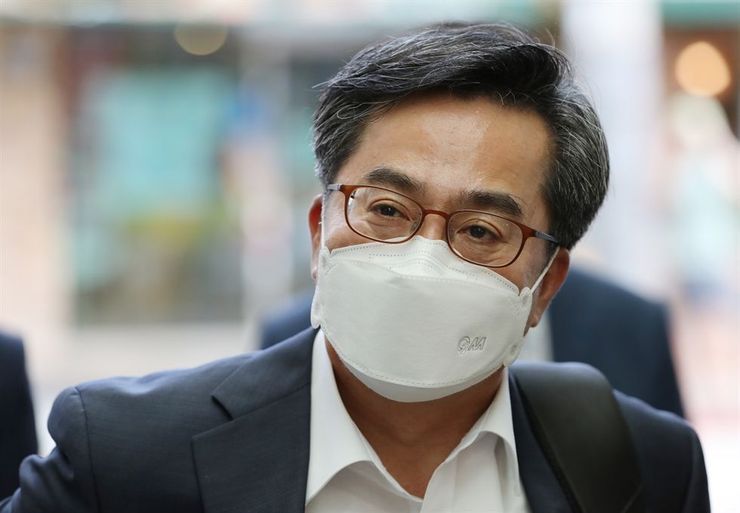
| Former Deputy Prime Minister Kim Dong-yeon visits a traditional market in Eumseong County, North Chungcheong Province, Friday, after announcing his bid to run in the presidential election. Yonhap |
By Nam Hyun-woo
Former Deputy Prime Minister Kim Dong-yeon, who announced his presidential bid recently, is expected to shake up the presidential election next year, as he will likely appeal to uncommitted voters who account for a significant portion of the country’s electorate, despite Korea’s decades-long political structure, based on two dominant parties.
Kim held a press conference in his hometown of Eumseong County, North Chungcheong Province, Friday, and announced that he will run for the presidential election in next March.
“There are many contenders whose presence is like that of a conglomerate or a medium-sized company, but I will begin my campaign with the mindset of starting a venture company,” said Kim, who served as the country’s finance minister. “I don’t want to piggyback on the conventional political community.”
Kim served as the deputy prime minister and the finance minister from June 2017 to December 2018, and has been receiving calls from both the liberal ruling Democratic Party of Korea (DPK) and the conservative main opposition People Power Party (PPP) to join their respective parties. So far, he has not accepted either party’s offer.
“During the April 7 by-elections, I was recommended to run by both parties, and recently received an offer to become the prime minister,” Kim said. “However, I refused them all because I am convinced that the current value of the established political powers will not be able to address the archaic structural problems of our society.”
Kim noted that he wants to benchmark the election of French President Emmanuel Macron, who was a top economic bureaucrat and launched a successful presidential campaign via his own political movement.
Observers say that Kim’s future movements could change the dynamics of the current presidential race, currently dominated by the liberal DPK and the conservative PPP, given the significant portion of uncommitted voters and centrists.
According to a joint poll conducted on Aug. 13 and 14 by the Korea Society Opinion Institute and broadcaster TBS, 31.6 percent of 1,007 respondents said that they are centrists, followed by 33.4 percent identifying as conservatives and 27.7 percent as liberals.
In another poll conducted on Aug. 17 to 19 by Gallup Korea, 24 percent of 1,001 respondents said that they don’t support any political party, followed by 32 percent who say they support the DPK and 31 percent who say they support the PPP.
Although Kim said that he will finish the presidential race as a third-party candidate, questions continue as to whether he will be able to keep his promise, given his previous election history.
There were a slew of big name politicians who sought to become the president as a third-party candidate, but most of them even failed to finish the race and withdrew their bids to form a single candidacy with one of the dominant parties, due to their lack of a home turf, as well as funding problems.
In 1992, Hyundai Motor Group founder Chung Ju-yung garnered attention as a third-party presidential candidate, but ended in third place in the election. In the following election in 1997, Lee In-je, who lost in the primary of the PPP’s predecessor, the New Korea Party, left the party and created his own party, but that only resulted in the splitting of conservative voters.
In other elections, former seven-term lawmaker Chung Mong-joon, former Prime Minister Goh Kun, former Yuhan-Kimberly CEO Moon Kook-hyun and the current People Party Chair Ahn Cheol-soo have all garnered attention as fresh figures outside of the two-party system, but all have ultimately ended up withdrawing their campaigns or receiving small numbers of votes.
Due to these precedents, pundits see Kim’s candidacy as potentially bringing in centrist support, which will increase his political presence in the future.
Kim’s life is widely viewed as a model rags-to-riches story. He started earning money at the age of 17 to help support his widowed mother and three siblings, right after graduating from high school. He studied at a nighttime college and passed the civil service exam to join the economic planning board.
Politically, he is considered a centrist. During the conservative Lee Myung-bak administration, he served as the second vice finance minister and became the minister of policy coordination in the conservative Park Geun-hye administration. After serving as the president of Ajou University from 2015 to 2017, he was appointed as the finance minister of the liberal Moon Jae-in administration.
 |
| Former Deputy Prime Minister Kim Dong-yeon, right, talks with a woman at a traditional market in Eumseong, North Chungcheong Province, Friday. Yonhap |
Former finance minister’s presidential bid expected to be game-changer
Source: Buhay Kapa PH


0 Comments