

 |
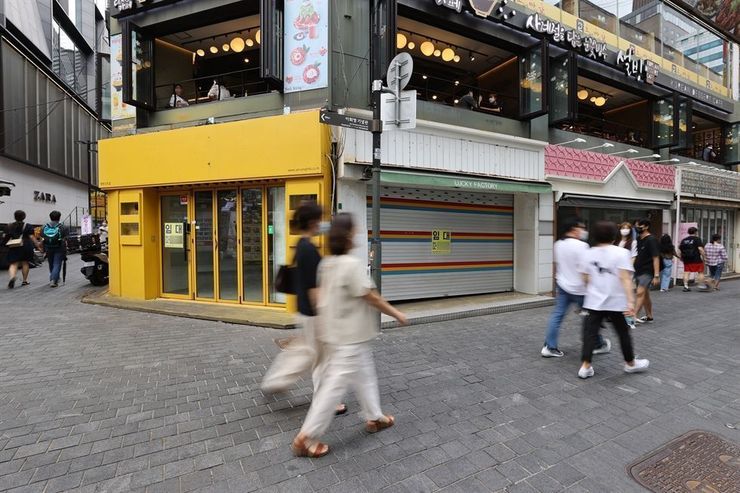
| Streets in Myeong-dong are nearly empty due to the impact of the fourth wave of COVID-19 infections here, Sunday. Yonhap |
Consolidate fiscal deficit to dip to mid-3 percent of GDP
By Lee Kyung-min
The liberal ruling Democratic Party of Korea (DPK) and the government are fine-tuning a spending plan of over 600 trillion won ($506 billion) for next year, an increase of 8 percent from this year’s budget of 558 trillion won, in a continued expansionary policy.
The spread of the Delta variant of the coronavirus is impacting the recovery prospects of the country’s economy. The continued containment measures have been hitting service- and retail-oriented industries ― the main grounds of small- and medium-sized enterprises (SMEs).
The government plans to increase the country-wide financial assistance to SMEs that are seeing rapid profit deterioration because of the continued social distancing rules. Specifically, about 600 billion won was earmarked to compensate for the losses brought on by the government-mandated gathering bans and reductions to operating hours, but the figure is expected to surge with the ongoing fourth wave of infections factored in.
The new budget includes expanded spending plans for vaccines, given the possibility of further virus mutations. Also included are ways to prevent further divides in education and childcare between the haves and the have-nots, which have become extra pronounced due to the health crisis, as illustrated by the increase in childcare allowances and expansion of state scholarships.
The Ministry of Strategy and Finance and the ruling DPK are ironing out the specifics of the budget, Sunday, before submitting it to the National Assembly early next month. The government and the DPK had planned to meet the 7 percent increase range target, but the failure to meet the earlier target was mostly due to Delta, with the country’s daily caseloads standing at well over 1,000 since early July.
Beyond the planned spending for post-pandemic efforts, a significant portion of the increased spending is earmarked for de-carbonization efforts, a major part of the green and digital initiatives of the overarching Korean New Deal drive.
Over 30 trillion won will be spent to advance the Korean New Deal 2.0, a more comprehensive version of the growth plan, placing more emphasis on inclusion of low-income earners and the self-employed, groups that are left out of the rapid changes in the corporate landscape amid digitization. Additionally, a fund will be set up to better respond to climate challenges with the goal of achieving carbon neutrality by 2050.
The government debt will exceed 1,000 trillion won by the end of next year, but the consolidated fiscal deficit will narrow down closer to 3 percent of the country’s GDP, down from the initial estimate of 4.4 percent.
The budget increase in the 8 percent range for next year is the continuation of this year’s 8.9 percent year-on-year rise, with the budget total amounting to 602 trillion won if the increase is 8 percent. It will climb further to 605 trillion won if the rise is 8.5 percent.
This figure well overshoots the previous target increase of up to 7.5 percent discussed by key economic advisers of President Moon Jae-in, signaling the continuation of pandemic-triggered emergency spending throughout the year. Government debt is expected to climb to 964 trillion won by the end of this year, and is likely to surpass 1,000 trillion won by the end of next year.
Expansionary fiscal policy to continue
Source: Buhay Kapa PH


0 Comments