

 |
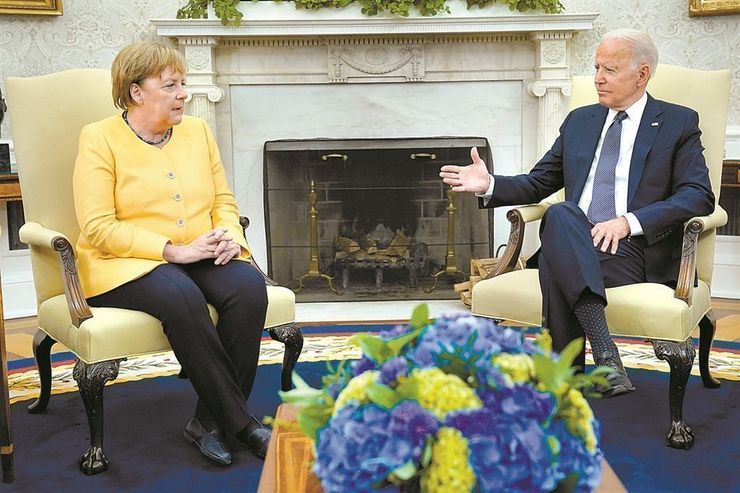
| U.S. President Joe Biden meets with German Chancellor Angela Merkel in the Oval Office of the White House in Washington, July 15. AP-Yonhap |
The United States and Germany on Wednesday announced a deal to allow the completion of a controversial Russian gas pipeline to Europe without the imposition of further U.S. sanctions. The agreement aims to stanch fears about European dependence on Russian energy, but it was immediately assailed by critics who said it doesn’t go far enough.
Under the terms of the deal, the U.S. and Germany committed to countering any Russian attempt to use the Nord Stream 2 pipeline as a political weapon. And, they agreed to support Ukraine and Poland, both of which are bypassed by the project and fear Russia’s intentions, by funding alternative energy and development projects.
“The United States and Germany are united in their determination to hold Russia to account for its aggression and malign activities by imposing costs via sanctions and other tools” they said in a joint statement that covered Nord Stream 2 as well as Russia’s support for separatists in Ukraine.
“Should Russia attempt to use energy as a weapon or commit further aggressive acts against Ukraine, Germany will take action at the national level and press for effective measures at the European level, including sanctions, to limit Russian export capabilities to Europe in the energy sector,” it said.
The Nord Stream 2 project has posed a major foreign policy dilemma for the Biden administration. U.S. officials from both parties have long feared that it would give Russia too much power over European gas supplies. But the pipeline is almost completed and the U.S. has been determined to rebuild ties with Germany that were damaged during the Trump administration.
Poland and Ukraine expressed their displeasure over the decision to allow the pipeline’s completion and said the efforts to reduce the Russian security threat were not sufficient.
“This decision has created a political, military and energy threat for Ukraine and Central Europe, while increasing Russia’s potential to destabilize the security situation in Europe, perpetuating divisions among NATO and European Union member states,” the Polish and Ukrainian foreign ministers said in a joint statement.
The agreement is not a clear political win for either President Joe Biden or German Chancellor Angela Merkel, an unabashed supporter of the pipeline who will step down later this year. For Biden, he risks appearing weak as it relates to Russia, and Merkel’s governing party faces a serious challenge from Germany’s Green Party, which opposes the pipeline, in September elections. (AP)
US, Germany seal deal on contentious Russian gas pipeline
Source: Buhay Kapa PH


0 Comments