

 |
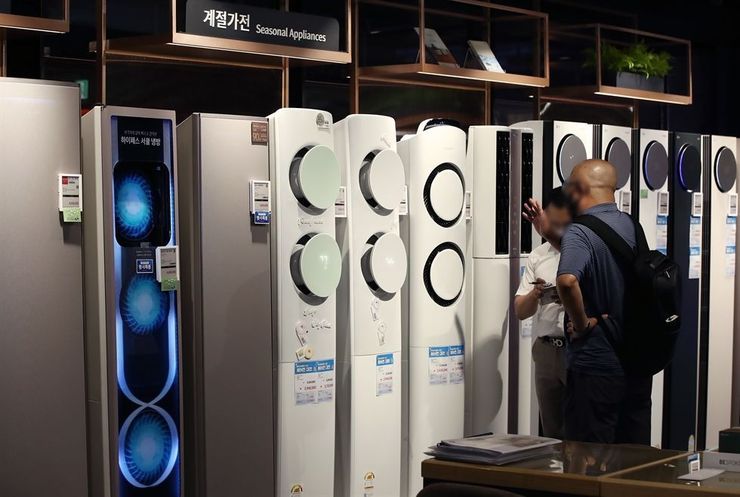
| Shoppers look at air conditioners on display in an appliance store in Yongsan District in central Seoul, Thursday. Yonhap |
Country may log hottest summer on record
By Yi Whan-woo
Korea is at risk of power shortages as the extreme summer heat is causing energy demand to spike, sparking fears that the electricity reserve level may drop below 10 percent, the minimum required percentage to avoid a possible blackout.
Under these circumstances, the government’s nuclear phase-out policy is believed to be worsening the situation.
Nuclear energy, according to state-run Korea Electric Power Corp (KEPCO), is the second-largest source of electricity here after coal; but one-third of the country’s 24 nuclear reactors are currently not available due to safety maintenance or other concerns.
“The government has been overly aggressive in its nuclear phase-out policy and as a result the supply of electricity is now in a very unstable situation,” said Joo Han-gyu, a nuclear engineering professor at Seoul National University, Friday.
In particular, he noted that government approval for operating the most recently built nuclear reactor, Shin Hanwool No. 1, has been delayed. It is currently undergoing test runs and is expected to be operating normally by March next year.
Joo warned of a possible blackout for the first time since 2011, if the demand for electricity goes beyond supply levels during peak hours.
He said that demand for electricity has been setting new yearly highs during peak hours this week ― 85 million kilowatts on Monday, 87.1 million kilowatts on Tuesday and 88.09 million kilowatts on Wednesday.
The demand for electricity this week is higher than that of last week, which ranged between 76.2 million and 81.1 million kilowatts.
The increased demand comes as the temperature nationwide surpasses 30 degrees Celsius, prompting the Korea Meteorological Administration (KMA) to issue heat wave advisories and warnings for most of the country.
The KMA forecast that this year’s short-lived monsoon season will end completely next Tuesday, and that a prolonged extreme heat wave will then engulf the nation.
It is forecast that the country may log in the hottest summer on record, with the mercury reaching beyond the all-time high of 40.7 degrees Celsius set in 2018 and the second-highest record of 39.4 degrees Celsius in 1994.
The Ministry of Trade, Industry and Energy along with state-run energy companies are scrambling to take preparatory measures, in line with the ministry’s speculation that the ratio of the remaining energy capacity to the maximum demand may fall to as low as 4.2 percent.
The ratio should be no lower than a minimum 10 percent in order to prevent blackouts. Korea last had a blackout in September 2011 ― which was unprecedented in its scale during peacetime ― as KEPCO failed to cope with a surge in electricity use. The energy reserve ratio went as low as 5 percent back then.
Fears growing over possible blackouts amid scorching weather
Source: Buhay Kapa PH


0 Comments