

 |
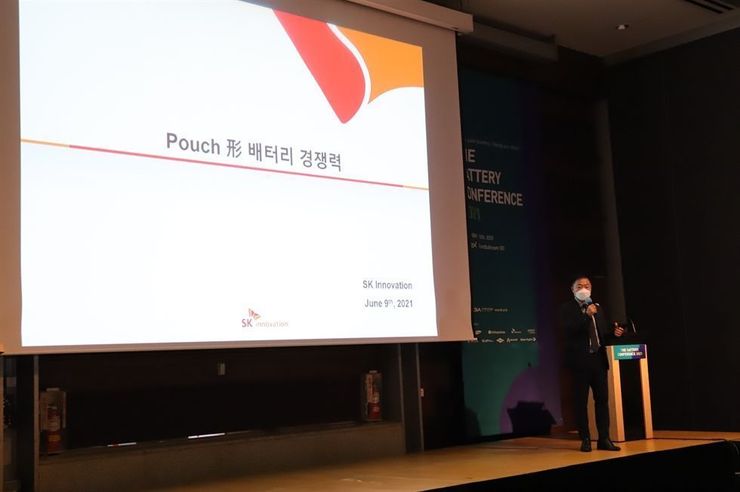
| Lee Jon-ha, the head of SK Innovation’s Battery Development Center, gives a presentation at The Battery Conference 2021 held at COEX in Seoul, on June 18. Courtesy of SK Innovation |
By Kim Jae-heun
SK Innovation Battery Development Center head Lee Jon-ha revealed what makes a battery catch fire and suggested ways to deal with such risks during the Battery Conference 2021 held by the Korea Battery Industry Association.
The conference, which took place at COEX on June 9 and 10 to mark its 10th anniversary, invited battery experts from around the world to seek new strategies for the industry and explore various aspects of the future of the battery market.
Lee spoke at the conference about the competitiveness of pouch cell batteries made by SK Innovation, in particular its technology and safety.
Until now, not a single battery SK produced for approximately 2.5 million electric vehicles has caught on fire.
The head of the center first explained the cause of the fire that can break out from a battery’s individual cells or the battery packs that bind 300 to 400 cells together and suggested a solution.
The biggest reason for a battery to catch on fire in its normal condition is an “internal short circuit.” Internal short circuit refers to a situation where the charge in positive and negative poles built up inside a cell come into direct contact and a chemical reaction occurs ― causing a fire, he said.
Lee specifically cited five causes of internal short circuits: poor alignment, absence of separation film, inflow of metal debris, internal deformation and damage to the separation membrane.
An alignment defect is when the positive and negative poles are not properly positioned during manufacturing. Rectangular poles and separation film are stacked in multiple layers ― like sheets of paper ― inside the battery. If these materials are not accurately stacked up and the corners of the negative and positive poles stick out, they can cause fires.
Also, when the separation films stacked between the negative and positive poles failed to properly block each other or a material is left out, this can also result in fire.
Inflow of metal debris is mainly caused by residue spraying onto the cells during welding. The foreign substances stick to the metal and may cause fire due to friction.
Internal deformation usually occurs during the manufacturing process.
When the material is rolled, curvature occurs at the corners. This may cause the curved part and the flat part to buckle due to different expansion properties when the battery is in use. Chemical reactions occur intensively at such buckled points, resulting in a bunch of abrasive crystals catching on fire.
The last cause of battery fires with a secondary battery is when the separation film is damaged during the charging and discharging process.
When charging and discharging cylindrical batteries, the inside of the battery expands and since the cylindrical materials are tightly rolled, it can cause pressure on the separator due to the expanding force.
If this situation occurs repeatedly, the fine pores of the separation film can slowly become deformed and may even ignite.


0 Comments