

 |
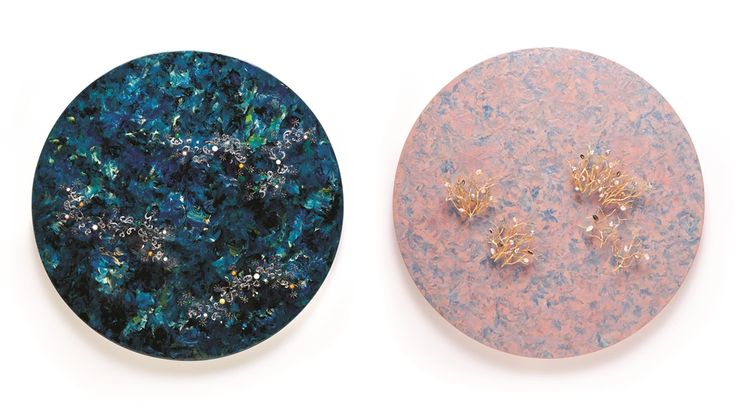
| Part of Chae Rimm’s “Talking with Trees” series (2018) / Courtesy of Hakgojae Gallery |
By Park Han-sol
Jewelry design is often characterized as a form of wearable art. When they’re not decoratively worn or displayed in a highly secure setting, the gemstones are usually tucked inside a safe, away from the gaze of viewers and the risk of theft. For Chae Rimm, whose career as a jewelry designer had been continuously on the rise since 2000, this hiddenness became a point of frustration. “Seeing my works making splendid, yet only brief, appearances at exhibitions, before being boxed up once again and put away in the dark, weighed heavily on my mind,” she said.
“I wanted to find a new way for these jewels that were hidden from public view to be able to communicate with people in broad daylight,” she added.
She found her answer in the unique combination of jewelry design and Korean traditional lacquer craft. A total of 144 paintings by the designer-turned-artist are on display at the exhibition, “Chae Rimm: Ott, Au Milieu de la Vie,” at Hakgojae Gallery in Jongno District, Seoul.
The artist’s first name is Rimm, meaning “forest” in Chinese characters, and she has imbued that theme in her artworks. For instance, her “Talking with Trees” and “Dreaming” series portray the serene, dreamlike scenery of the woods during different seasons.
Instead of brush strokes, delicate strands of gold and silver, as well as pieces of mother-of-pearl and other gems, become glistening pine trees and shrubs nestled in the wilderness on the surface of Chae’s lacquer-coated wooden canvases. Her use of traditional materials like hanji (Korean mulberry paper) and hemp cloth further adds to the mystique of nature depicted in her works.
 |
| Chae Rimm’s “Dreaming” (2018) / Courtesy of Hakgojae Gallery |
Although lacquer craft has existed and been passed down for generations, it has been overshadowed since the invention of synthetic resins. The artist brought the several-thousand-years-old practice to life, but with her own unique touch.
“Traditional lacquer painting requires a high level of humidity and a fixed temperature range of 20-25 degrees Celsius, but I purposefully made changes to such conditions to experiment with new things,” she said. “As a result, I was able to use the craft to convey an effect similar to pastels, watercolors, oil paintings and pointillist techniques.”
But reinterpreting such laborious artistic practices has never been an easy task, she admitted.
“There is a saying that lacquer is the tears of the gods. It’s the sap that the lacquer tree secretes in order to protect itself, and the amount that can be collected is infinitesimally small. And the process of working with it is equally arduous.”
Chae’s work begins by mixing the sap with traditional pigments. She has to apply the mixture on a wooden panel repeatedly, drying it up to 40 times in between each application. Physical pain often follows, as she suffers from poisoning from the fumes, which reddens her face, neck and hands, as well as fills her eyes with tears.
But the moment the dull, somber lacquer paint magically brightens and finds its true vibrant color makes her forget about the pain and leaves her with a renewed sense of healing and recovery.
“It’s then when lacquer ‘blossoms.’ When it meets the right amount of humidity and temperature, it comes into bloom like a flower.”


0 Comments