

 |
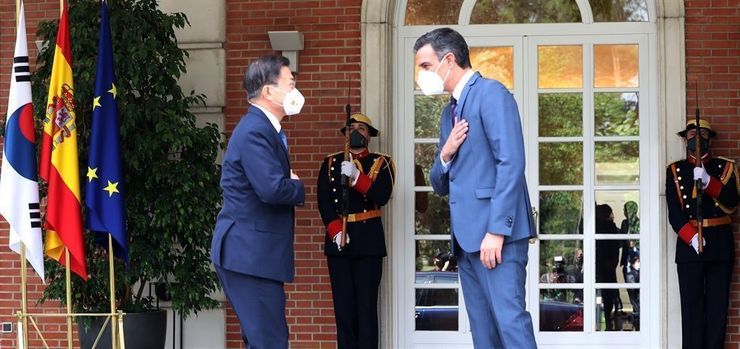
| President Moon Jae-in exchanges greetings with Spanish Prime Minister Pedro Sanchez during their meeting at Moncloa Palace, Madrid, Wednesday (local time). Yonhap |
By Nam Hyun-woo, Joint Press Corps
President Moon Jae-in and Spanish Prime Minister Pedro Sanchez agreed Wednesday (local time) to elevate the two countries’ relations to a strategic partnership. They also signed multiple agreements on diplomatic, multilateral, economic, technological and cultural ties.
During their meeting at Moncloa Palace, which is the official residence of the prime minister, the leaders recognized the necessity to upgrade bilateral relations to such a partnership, in a bid to strengthen the two countries’ friendship and practical exchanges.
Korea uses the term “strategic partnership” as diplomatic rhetoric to describe bilateral relations in which two countries jointly discuss peace, regional and international issues ― it maintains these partnerships with more than 10 countries. The term is widely accepted as the third-closest bilateral relations that Korea has with other countries, following its comprehensive strategic alliance with the U.S., and strategic cooperative partnerships with China, Russia, Vietnam and Columbia.
Korea and Spain began diplomatic relations in 1950 and have been developing cooperation in the political, economic and cultural sectors. Moon’s trip to Spain is a reciprocal arrangement following King Felipe VI’s visit to Seoul in 2019.

 |
| President Moon Jae-in speaks with Spanish Prime Minister Pedro Sanchez during their meeting at Moncloa Palace, Madrid, Wednesday (local time). Yonhap |
In a joint statement, Moon and Sanchez stated their countries’ partnership entailed cooperation in politics, diplomacy, international affairs, global peace, economic cooperation, science and culture. This includes support for a stronger, reformed and reinvigorated rules-based multilateralism, concurrence on the need to reform the United Nations Security Council, and the strengthening of bilateral economic exchanges through the Joint Economic Commission and the Korea-Spain Economic Cooperation Committee.
They also agreed to make efforts to increase bilateral investment and exchanges to the same level as before the COVID-19 pandemic.
The leaders recognized Korean and Spanish building contractors’ joint entry into third markets over the past 40 years, and pledged to strengthen this cooperation to expand into the construction markets of South and Central America and Asia.
Spain showed support for Moon’s peace process for the Korean Peninsula, with a joint statement saying, “the two leaders reaffirmed their commitment to complete denuclearization and the establishment of a permanent peace on the Korean Peninsula achieved through diplomacy and dialogue.”
Along with the joint statement, the two leaders signed MOUs, which state that the two countries will strengthen their exchanges in policies and technologies to nurture future industries and startups, and develop alternative energy.
In terms of travel, the two leaders regretted the temporary reduction in tourist exchanges between the two countries due to the COVID-19 pandemic and expressed their determination to overcome its negative consequences and maintain the uptrend in reciprocal tourist visits.
In this regard, Culture, Sports and Tourism Minister Hwang Hee, who is accompanying Moon on his visit to Spain, said Madrid had “expressed keen interest on tourism exchanges between the two countries upon,” and the European country was seeking to apply Korea’s info-tech to its abundant tourism assets and together advance into tourism markets in Europe and South America.
Hwang said the two were holding talks on establishing a “travel bubble,” a partnership under which fully vaccinated people are exempted from mandatory quarantine upon entry to each other’s countries. He added, however, this should come after the two countries’ quarantine authorities decide to acknowledge each other’s vaccination programs.


![[ANALYSIS] Heavy cost-cutting to hurt Samsung’s competitiveness](https://lh3.googleusercontent.com/blogger_img_proxy/AEn0k_tz1cwVF5D1j3enyH3tDlLXyrXU9QheOl2TDFX2UTFxbRJF9Doer80tuShKYRJh8gRBCbQXtZjzG9jUzzDxYAkrEwfMccAnjlQT2-peFg0Tui_jlFTidny9Zg0KGj210pQNOXfyJpq9rP9LFt5xTqGhmq3rMiYTI2a1tPsFTQxmzscn9wTER1fYat6gqvpfS4w6K57dAQ3Ltyo=w100)

0 Comments